
Pier and Beam vs. Slab Foundation — Which Has Higher Termite Risk in Texas?
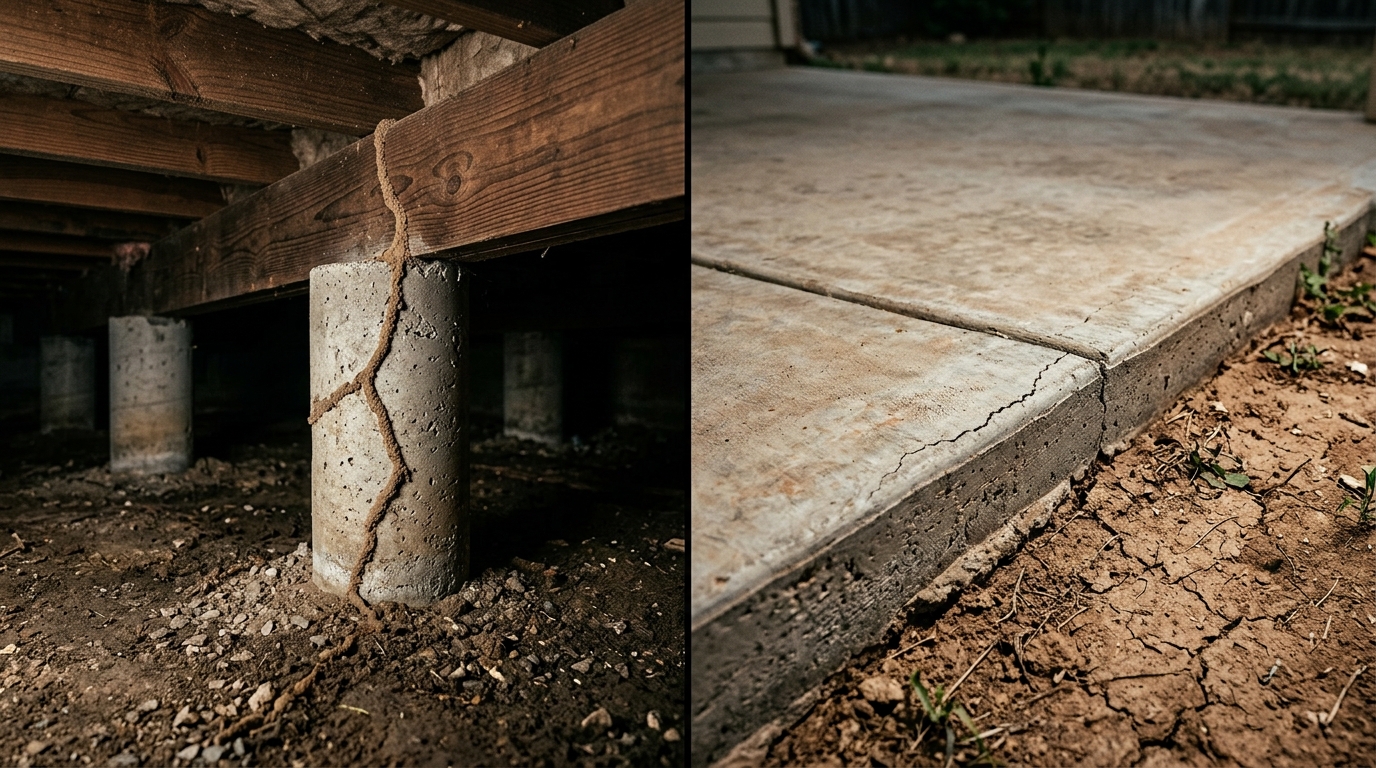
One of the most common questions from homeowners in Walker County and East Texas is whether their foundation type affects their termite risk. The short answer is yes — but not in the direction most people expect. Pier-and-beam foundations are easier to inspect and treat, but harder to protect passively. Slab foundations are harder to inspect and treat, but infestations are often more advanced by the time they're discovered.
Here is a direct comparison that will tell you what you actually need to know.
Pier and Beam Foundations: The Risk Profile
A pier-and-beam foundation places your home's structural floor framing — floor joists, sill plates, and girders — directly above a crawl space that sits on or near the soil. The wood is elevated, but it's not protected by concrete between it and the ground.
This creates several specific termite entry scenarios:
- Wood-to-soil contact: Any wood element that touches or is embedded in the soil gives termites direct access with no barrier. This is the most common cause of infestation in older pier-and-beam homes — a post, step support, or shim that settles until it contacts the ground.
- Mud tubes on concrete piers: Subterranean termites cannot travel in open air — they build mud tubes to protect themselves. In pier-and-beam homes, mud tubes running up the face of concrete piers from the soil to the sill plate above are the classic infestation indicator. They're visible during inspection but only if someone actually goes into the crawl space to look.
- Crawl space moisture: A damp crawl space with poor ventilation keeps the soil moist and warm — ideal termite habitat. Homes in East Texas with crawl spaces that don't drain well are at significantly higher risk because the environment below the floor is essentially a termite incubator.
- Original wood quality degradation: Older pier-and-beam homes often have heart pine or dense-grain lumber that is more naturally termite-resistant than modern lumber. But that resistance diminishes over decades, especially in conditions of alternating moisture and drying.
Advantages of Pier and Beam for Termite Management
The crawl space is accessible. An inspector can physically enter and examine the underside of the floor structure. Mud tubes, damaged wood, and active termite galleries are visible. Treatment is also more straightforward — soil in the crawl space can be directly treated, and the perimeter trench can be supplemented with direct crawl space soil treatment without the drilling required on slab.
Slab Foundations: The Risk Profile
A concrete slab foundation places a continuous concrete barrier between the soil and the structure. Many homeowners assume this means termite protection — it does not.
Subterranean termites can exploit any gap in concrete as small as 1/32 of an inch. Concrete is not a termite barrier; it's a surface with vulnerabilities that change over time.
- Expansion joints: Concrete slabs crack and shift with Texas soil movement (particularly in clay-heavy East Texas soils). The expansion joints built into slab construction are intentional gaps that termites exploit routinely.
- Plumbing and utility penetrations: Every pipe that enters the structure from below — water, gas, electrical conduit — passes through a hole in the concrete. The gap around that pipe, however small, is a termite entry point. These are the most common entry points we find during slab inspections.
- Hollow areas under slabs: Soil subsidence, soil washing, and void formation beneath slab foundations create spaces that termites colonize. When termites find a void under a slab near wood framing, they can build galleries extensively without ever producing a visible exterior mud tube.
- Foundation perimeter where slab meets grade: Where the slab edge meets the exterior soil, a small gap often forms as the exterior grade settles away from the concrete. This edge is a direct entry point for termites moving from the perimeter soil into the wall framing above.
Why Slab Infestations Are Often More Severe When Found
In a pier-and-beam home, termite activity in the crawl space is visible during inspection. In a slab home, termites that enter through a plumbing penetration can travel inside the wall framing and feed for years without producing exterior evidence. By the time mud tubes appear on an interior wall baseboard — or a homeowner notices buckled flooring — the infestation has typically been active for multiple years.
This doesn't mean slab homes have worse infestations — it means they're often discovered later, when more structural damage has already occurred. That's an argument for annual inspection even on slab homes, not for pier and beam being safer.
Treatment Differences by Foundation Type
Treating Pier and Beam Homes
- Perimeter trench and treat — standard liquid barrier around the exterior
- Crawl space soil treatment — direct treatment of exposed soil beneath the floor
- Spot treatment of accessible structural wood where active galleries are found
- No drilling required unless there are concrete areas (patio, garage slab)
Treating Slab Foundation Homes
- Perimeter trench and treat — standard liquid barrier around the exterior
- Drilling through concrete — required to reach the soil beneath slab sections, particularly patios, garage floors, and interior slab areas adjacent to plumbing
- Injection at pipe penetration points — sealant plus termiticide injection at each plumbing entry point
- Drilling adds cost and time compared to pier-and-beam treatment
Which Foundation Type Should Be Inspected More Frequently?
Both should be inspected annually in East Texas. The argument for more frequent inspection applies to both:
- Pier and beam: Annual inspection means catching activity at the mud tube stage, before it becomes structural damage.
- Slab: Annual inspection means finding entry points and interior evidence before years of hidden feeding compound into major framing damage.
If you have not had a termite inspection in the last year — regardless of foundation type — schedule one. We inspect both foundation types across Walker County and surrounding areas. Call 936-935-0197.
Quick Reference Comparison
| Factor | Pier & Beam | Slab |
|---|---|---|
| Primary entry point | Wood-to-soil contact, mud tubes on piers | Plumbing penetrations, expansion joints, slab edges |
| Inspection visibility | High — crawl space accessible | Low — activity hidden inside walls |
| Treatment complexity | Lower — direct soil access | Higher — drilling through concrete required |
| Typical damage when found | Earlier detection = less damage | Later detection = often more damage |
| Inspection frequency recommended | Annual | Annual |
Protect Your Home
Before It's Too Late
Licensed & insured termite specialists serving Walker County.
Same-day inspections. Honest pricing. No contracts.
Mon–Fri 7 AM – 6 PM, Sat 8 AM – 4 PM