
Subterranean vs. Formosan Termites in East Texas — What's the Difference?
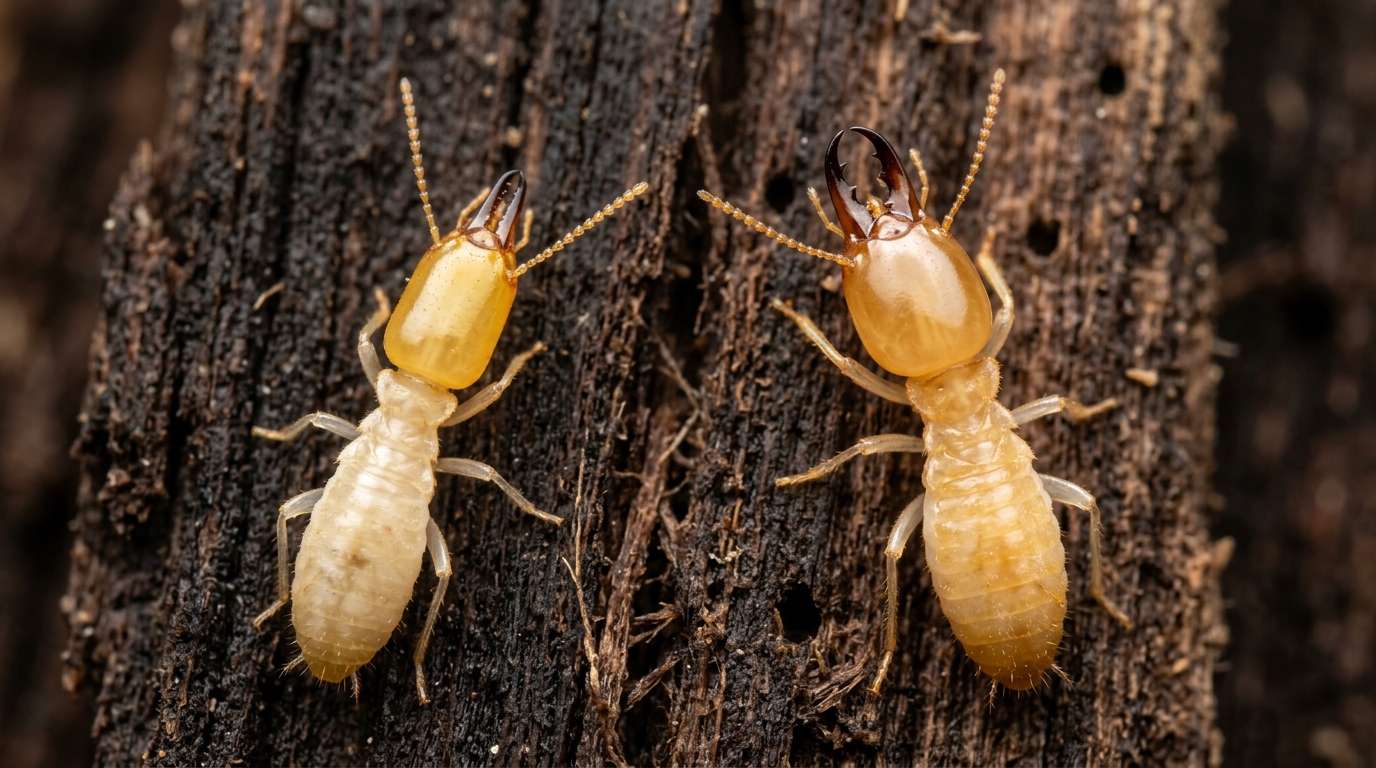
If you have been told you have subterranean termites in your East Texas home, the first follow-up question should be: which species? Native subterranean termites and Formosan subterranean termites are both found in Walker County and throughout East Texas, both live underground, and both build mud tubes. But the differences in how they behave — and what it takes to manage them — are significant enough that the distinction matters for treatment planning.
Native Subterranean Termites (Reticulitermes spp.)
Native subterranean termites are the most common termite in Texas and the species most homeowners encounter. In Walker County, the predominant native species are Reticulitermes flavipes (eastern subterranean) and Reticulitermes tibialis (western subterranean), though range overlaps in East Texas and precise species identification typically requires microscopy.
Key characteristics:
- Colony size: 60,000 to 1 million workers in a mature colony
- Foraging range: Up to 100 meters from the main colony — covering most residential lots
- Damage rate: A large colony can consume about a pound of wood per week under ideal conditions. Structural damage typically takes several years to become significant.
- Swarming: Typically in spring, during daylight hours after rain — mid-morning to early afternoon. Workers have two wing pairs of equal length.
- Mud tubes: Narrow, roughly pencil-diameter tubes with a uniform, smooth appearance
- Nest location: Always connected to soil. Cannot survive long-term without ground contact.
Formosan Subterranean Termites (Coptotermes formosanus)
Formosan termites are an introduced species, established in the Gulf Coast states since the mid-20th century. They are now well-established throughout East Texas, including Walker, Montgomery, and Polk counties. The same general biology applies — underground colony, mud tubes, wood consumption — but the scale and management complexity are different.
Key characteristics:
- Colony size: 2 to 8 million workers in a mature colony — 3 to 10 times larger than native colonies
- Foraging range: Up to 300 meters from the main colony
- Damage rate: Substantially faster than native species due to colony size. Formosan termites can cause significant structural damage in months, not years.
- Swarming: At night, attracted to light sources. Primary swarm season is late March through June in East Texas, typically on warm, humid evenings after rain.
- Mud tubes: Often wider and more irregular than native tubes, sometimes with carton material incorporated
- Carton nests: The critical difference. Formosan termites can build above-ground carton nests — composite structures of chewed wood fiber, soil, and saliva — that allow the colony to retain moisture without returning to soil. A colony with an established carton nest inside a wall void or roof space can survive a perimeter soil barrier treatment.
Side by Side: What Matters for Homeowners
| Factor | Native Subterranean | Formosan |
|---|---|---|
| Colony size | 60K–1M | 2M–8M |
| Swarm time | Daytime, spring | Nighttime, attracted to light, Mar–Jun |
| Above-ground nest? | No | Yes — carton nests in wall voids |
| Damage rate | Slow (years) | Fast (months) |
| Standard liquid barrier effective? | Yes | Yes, but carton nests may require additional treatment |
How to Tell Which Species You Have
Definitive species identification requires examination of workers and soldiers under magnification — this is part of what a professional inspection provides. However, there are useful field indicators:
- Nighttime swarming near lights → strong Formosan indicator
- Carton material (dark, spongy, wood-and-soil composite inside walls) → Formosan
- Daytime swarm after rain in spring → likely native subterranean
- Rapid, widespread damage appearing over a short period → Formosan is more likely
If you are unsure, the correct response is the same regardless of species: call for an inspection. The treatment plan will differ based on what is found, and knowing the species before treatment ensures the right protocol is applied.
In Huntsville and Walker County, call 936-935-0197 to schedule. We serve the full area with same-day and next-day availability.
Protect Your Home
Before It's Too Late
Licensed & insured termite specialists serving Walker County.
Same-day inspections. Honest pricing. No contracts.
Mon–Fri 7 AM – 6 PM, Sat 8 AM – 4 PM